
BLOG
Resume Parsing Software: What It Is and How to Choose the Right One
November 2026 · 10 min read
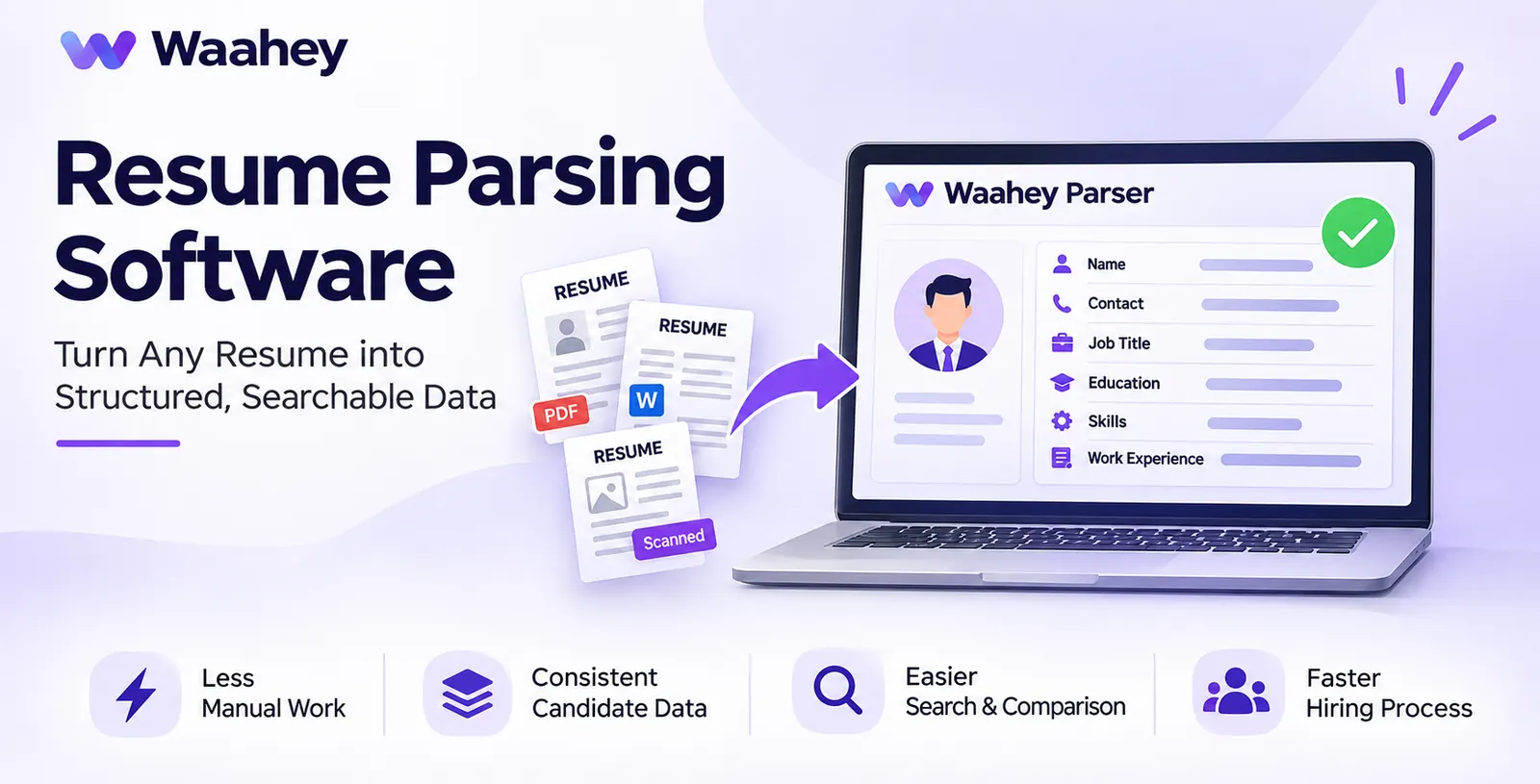
A single job posting can bring in dozens or even hundreds of resumes, and no two look alike. One candidate sends a two-column PDF, another a Word file with tables, a third a scanned image. Someone on your team then retypes names, contact details, job titles and skills into a spreadsheet or tracking system, one record at a time.
That repetitive work is exactly what resume parsing software is meant to reduce. This guide explains what the software does, where it works well, where it still needs a human eye, and how to evaluate your options before you commit.
The Problem: Why Manual Resume Handling Slows Hiring
Resumes are written for people, not databases. The information recruiters need is there, but it is scattered across different layouts, headings and writing styles.
Manual handling creates several predictable problems:
- Repetitive data entry. Copying the same fields from document to document takes time that could go to candidate conversations.
- Inconsistent records. One person types "Sr. Developer" while another types "Senior Software Engineer," which makes searching unreliable later.
- Slower response times. When review depends on retyping, candidates wait longer for an answer.
- Hard-to-search archives. Resumes stored as loose files are difficult to filter by skill, location or experience.
For a small HR team or a growing business, these delays compound with every new opening.
How Resume Parsing Software Works
Resume parsing converts an unstructured document into organised fields. Most tools follow a similar sequence.
- Upload or intake. The resume file is added to the tool. Which file types are accepted varies by product.
- Text extraction. The software reads the text. Scanned or image-based documents typically need optical character recognition (OCR) first.
- Field identification. The tool tries to recognise which text is a name, an employer, a job title, a date range or a skill.
- Structured output. The identified details are placed into a consistent format, such as a table or profile view.
- Human review. A recruiter checks the result against the original document before relying on it.
Fields commonly extracted
Parsers generally aim to capture contact details, work history, education, skills and certifications. The exact set differs between tools, so always confirm coverage for the product you are considering.
Common Challenges in Resume Parsing
No parser handles every document perfectly. Knowing the common friction points helps you set realistic expectations.
- Creative layouts. Columns, icons, text boxes and graphics can confuse reading order.
- Scanned or low-quality files. Poor image quality makes text harder to read accurately.
- Ambiguous wording. A project name can look like an employer, or a degree can be abbreviated in an unfamiliar way.
- Date formats. "03/24," "March 2024" and "Spring 2024" all appear on real resumes.
- Career gaps and overlaps. Freelance work and parallel roles do not always fit a neat timeline.
Parsing also is not the same as evaluating. A parser organises what a candidate wrote; it does not judge fit.
Benefits of Automated Resume Parsing
When the tool suits your documents and the output is reviewed, teams commonly see practical gains:
- Less retyping, which frees recruiters for higher-value work.
- More consistent records, because every resume lands in the same structure.
- Easier comparison, since candidates can be viewed side by side.
- A more searchable talent pool, which helps when a similar role opens later.
- Smoother handoffs between recruiters, hiring managers and coordinators.
The size of these gains depends on your volume, document mix and review process, so measure them in your own workflow rather than assuming a number.
Practical Business Use Cases
- In-house HR at a growing company. A company hiring across several departments can use parsed profiles to build one consistent candidate view instead of keeping each hiring manager's folder separate.
- Recruitment agencies. Agencies receive resumes in every format imaginable. Structuring them quickly makes it easier to build shortlists for clients and to revisit past candidates for new roles.
- Talent acquisition teams. Teams running continuous hiring can keep a searchable pool of past applicants, which supports re-engagement without starting from zero.
A simple illustrative scenario
Imagine a recruiter who receives forty resumes for one opening. Instead of retyping each, she uploads them, reviews the structured output for each candidate against the original, corrects a few fields, and shares a clean comparison view with the hiring manager. The time saved goes into candidate calls. (This is an illustrative scenario, not a customer result.)
How to Choose Resume Parsing Software
Use this checklist when comparing tools:
| Criterion | Question to ask | Why it matters |
|---|---|---|
| Document support | Which file types and layouts are handled? | Your real resumes decide success. |
| Field coverage | Which fields are extracted? | Missing fields mean manual work. |
| Review workflow | How easy is it to check and correct results? | Verification is essential. |
| Output options | Can you export or view results in the format you need? | Output must fit your process. |
| Data privacy | How are candidate documents handled and stored? | Resumes contain personal data. |
| Scalability | Does it fit your monthly volume? | Volume affects cost and speed. |
| Support | Is help available when something looks wrong? | Edge cases always appear. |
Test any tool with a sample of your own resumes, including the messy ones, before deciding.
Best Practices and Limitations
- Verify important details. Check names, dates, contact information and key qualifications against the original resume.
- Keep humans in the decision. Parsed data supports your judgement; it does not replace it.
- Standardise where you can. Ask candidates for a common format when practical.
- Handle data responsibly. Resumes contain personal information, so follow your organisation's privacy obligations.
- Expect imperfect results. Automated extraction is not always accurate, especially on unusual layouts.
Frequently Asked Questions
- What is resume parsing software?
- It is a tool that reads resumes and organises their contents, such as contact details, experience and skills, into structured fields so they are easier to review, search and compare.
- Is resume parsing the same as resume screening?
- No. Parsing extracts and structures information. Screening involves deciding whether a candidate fits a role, which still needs human judgement.
- How accurate is a resume parser?
- Accuracy depends on the tool and the document. No parser is perfect, so verify important extracted details against the original resume.
- Who benefits most from resume parsing software?
- Recruiters, HR professionals, recruitment agencies, talent acquisition teams and growing businesses that handle regular resume volume.
Conclusion
Resume parsing software will not choose your next hire, but it can remove much of the retyping that slows hiring down. Choose a tool by testing it on your own documents, check how easy it is to review results, and always verify key details against the original resume.
Ready to see how structured resume data fits your workflow? Explore Waahey Parser and the broader document parser, or look at AI quizzes and AI Companion for related learning tools.
Ready to see how structured resume data fits your workflow?
Explore Waahey Parser and try it with your own documents to turn resumes into reviewable candidate profiles.
Keep exploring AI and learning
- Resume Screening Automation: A Practical Workflow for Recruiters
A practical recruiter workflow for resume screening automation—where parsing helps most, how to stay consistent, and why human judgement must stay in charge.
- How AI Is Changing the Way Students Learn in 2026
From personalized study paths to AI tutors and instant feedback, see how learners are using AI responsibly—and what it means for teachers and institutions.
- 10 Ways AI Can Help Teachers Save Time and Improve Learning
Discover 10 ways AI can help teachers save time, reduce admin tasks and enhance student learning, from quiz creation to real-time feedback and personalization.